

Artificial Intelligence is no longer a futuristic concept—it’s already reshaping the workplace. Whether you’re a freelancer, employee, entrepreneur, or business leader, one thing is becoming increasingly clear: AI literacy is no longer optional.
The professionals who learn how to work with AI will outperform those who resist it.
But here’s the challenge: AI moves fast. New terms, tools, and workflows appear almost weekly, making it easy to feel overwhelmed. If you’ve ever opened LinkedIn, sat in a meeting, or watched younger colleagues move faster with AI tools and wondered “Am I already falling behind?”—you’re not alone.
Based on the uploaded transcript , here’s a refined, SEO-friendly breakdown of a practical framework to help you move from AI beginner to AI power user.
Why AI Adaptation Matters More Than Ever
Imagine walking into your own workplace and suddenly not understanding the language being spoken.
Terms like:
- AI agents
- RAG
- MCP
- Prompt engineering
- AI automation
- Voice agents
For many professionals, this is already happening.
The uncomfortable truth? AI isn’t replacing every job overnight—but people who know how to use AI effectively may replace those who don’t.
According to industry research, a significant percentage of repetitive tasks can already be automated, and that number continues to grow.
But AI isn’t just about chatbots.
Modern AI spans:
- Text generation
- Research automation
- Image creation
- Video generation
- Coding assistance
- Data analysis
- Workflow automation
- Voice AI
Understanding this broader ecosystem is the first step toward staying relevant.
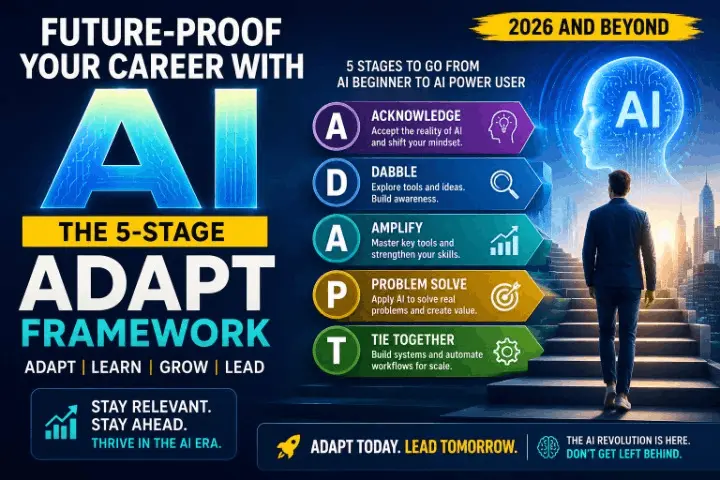
The ADAPT Framework: 5 Stages to Thrive in the AI Economy
A simple way to understand your AI journey is through the ADAPT framework:
A – Acknowledge
D – Dabble
A – Amplify
P – Problem Solve
T – Tie Together
Let’s break it down.
Stage 1: Acknowledge Reality
This is where most people struggle.
Common thoughts include:
- “AI won’t affect my industry.”
- “My work is too creative.”
- “Clients will always need humans.”
- “This technology is overhyped.”
While human creativity and judgment remain critical, denying AI’s impact can be a costly mistake.
The goal of this stage isn’t technical expertise.
It’s mindset.
You need to honestly ask:
- Am I learning the tools shaping my industry?
- Do I understand how competitors are using AI?
- Am I experimenting—or avoiding?
The people ahead in AI often aren’t more talented.
They simply started earlier.
Stage 2: Dabble Without Pressure
This is the exploration stage.
Not mastery.
Not monetization.
Just exposure.
Many people make the mistake of trying to become experts immediately. That usually leads to frustration.
Instead, start by testing a variety of AI tools.
Useful AI Tool Categories to Explore
Writing & Thinking
- ChatGPT
- Claude
- Gemini
These help with:
- brainstorming
- writing drafts
- summarizing
- idea generation
Research
Tools like Perplexity or NotebookLM can speed up information gathering dramatically.
Ideal for:
- report summaries
- PDF analysis
- quick fact-finding
- research synthesis
Image Generation
AI image tools can create:
- marketing visuals
- ad creatives
- concept art
- thumbnails
Video Creation
AI video platforms can help generate:
- explainer videos
- talking avatars
- short-form content
Automation
Workflow tools help connect apps and reduce repetitive work.
Examples:
- automating emails
- syncing databases
- lead capture workflows
Why Dabbling Matters
The goal is simple:
Build awareness.
You don’t need to memorize every tool.
You just need to develop intuition.
When a real problem appears, you’ll know AI might help solve it.
Why Most People Quit Here
This is where nearly everyone gets stuck.
Why?
Because experimentation feels productive—but often doesn’t create results.
You test:
- 20 tools
- 30 tools
- endless demos
- countless tutorials
But income doesn’t change.
Skills don’t deepen.
Confidence drops.
That’s because dabbling is only a temporary phase.
Stage 3: Amplify Your Core AI Skills
This is where progress becomes real.
Instead of trying everything, choose 3–5 tools that align with your work.
Examples:
For Writers
Best stack:
- ChatGPT / Claude
- Perplexity
- AI editing tools
For Developers
Best stack:
- Cursor
- Replit
- AI code assistants
For Marketers
Best stack:
- AI image generators
- copywriting tools
- automation workflows
For Content Creators
Best stack:
- voice tools
- video generators
- scripting assistants
AI Terms You Should Know in 2026
To operate confidently, understand these terms:
1. System Prompt
A set of instructions given to AI before interaction.
Think of it as onboarding an employee.
Example:
Instead of saying:
“Write customer support replies.”
You say:
“You are a calm customer support agent handling refund requests professionally.”
Better instructions = better outputs.
2. RAG (Retrieval-Augmented Generation)
RAG allows AI to access your documents or knowledge base.
Instead of guessing, AI pulls information from real sources.
Useful for:
- internal company knowledge
- customer support bots
- document assistants
3. MCP (Model Context Protocol)
Think of MCP as AI connectivity infrastructure.
It helps AI interact with:
- Slack
- calendars
- CRMs
- databases
- business tools
This turns AI from “chat assistant” into “task executor.”
4. Fine-Tuning
Training AI for a specialized use case.
Examples:
- legal drafting
- medical assistance
- customer support automation
General AI becomes domain-specific AI.
Stage 4: Solve Real Problems (This Is Where Money Starts)
This is the turning point.
Stop asking:
“Which AI tools are cool?”
Start asking:
“What expensive problems can AI solve?”
Businesses don’t pay for tools.
They pay for solutions.
Example 1: AI Marketing Workflow
Problem:
Need dozens of ad creatives quickly.
Traditional approach:
- hire agency
- wait weeks
- spend heavily
AI-powered approach:
- Generate product visuals
- Create multiple ad copy versions
- Build designs automatically
- Launch campaigns faster
- Analyze performance data
Result:
Faster execution, lower cost, more testing.
Example 2: AI Voice Receptionist
Problem:
Too many customer calls.
Solution:
Deploy AI voice systems that:
- answer instantly
- support multiple languages
- book appointments
- escalate complex cases
Benefits:
- lower staffing pressure
- improved customer response time
- 24/7 availability
The AI Career Opportunity Window
Right now, new roles are emerging fast:
High-Demand AI Jobs
- AI Automation Specialist
- Prompt Engineer
- AI Consultant
- AI Workflow Designer
- Voice AI Developer
- AI Operations Lead
Many of these roles didn’t exist recently.
And unlike traditional fields, many don’t require formal degrees.
Skills matter more than credentials.
Stage 5: Tie Everything Together
This is advanced AI leverage.
You’re no longer using isolated tools.
You’re designing systems.
Examples:
Your AI stack:
- reads your inbox
- prioritizes messages
- drafts replies
- schedules meetings
- researches competitors
- generates reports
Automatically.
At this stage, AI becomes your digital team.
This is where productivity scales massively.
3 Timeless Rules for the AI Era
1. AI Executes. Humans Direct.
AI follows instructions.
Humans define goals.
The person with clearer thinking wins.
2. Communication Is a Superpower
Knowing 20 tools matters less than communicating clearly.
A precise prompt beats random experimentation.
3. AI Is Becoming Baseline Skill
Soon, basic AI use will be expected.
Your competitive advantage won’t be using AI.
It will be using AI better than others.
Final Thoughts
The AI revolution isn’t waiting.
You don’t need to become an expert overnight.
But you do need to begin.
Start with awareness.
Experiment.
Choose your tools.
Solve real problems.
Then build systems.
Because the biggest risk today isn’t AI replacing your job.
It’s someone who understands AI outperforming you.