

If you lost everything tomorrow—no audience, no connections, no money—and had to get back to making $10,000 a month as fast as humanly possible, how would you do it?
The answer isn’t grinding away at old, outdated e-commerce methods. The entire landscape has shifted, and the bottleneck of doing everything manually is gone. What used to take two weeks and $500 to test can now be done in two days for under 50 bucks.
The secret is AI dropshipping. By building a highly efficient, automated system, you can leverage large language models (LLMs) to handle product research, competitor analysis, store building, and ad creative intelligence.
Here is the exact step-by-step playbook to get you there.
The Math Behind $10,000 a Month
Before diving into the system, you need to understand the numbers. Hitting $10,000 a month sounds like a massive mountain to climb, but when you break it down, it’s just math.
To hit $10k in a 30-day month, you need to make roughly $333 per day in profit. If you find a product that gives you a $50 profit margin per sale, you only need to sell about 6 to 7 units a day. That’s it. One viral video or one well-optimized ad campaign can easily knock that out.
To help you visualize your own targets, use this interactive calculator to figure out exactly how many daily sales you need based on your specific product pricing.Show me the visualization
Now that you know your targets, here is the 5-phase system to hit them.
Phase 1: Product Research & Scoring
In the past, finding a winning product was a guessing game. Now, you can use AI tools to scrape the internet, analyze trends, and score products automatically.
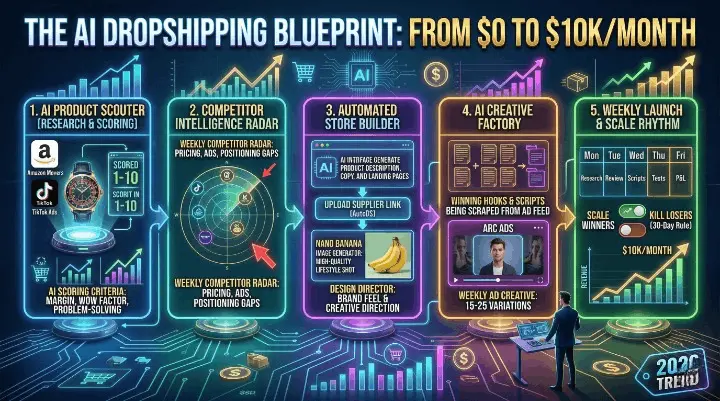
Using tools like Claude (specifically the Co-Work feature if you have it for automation), you can prompt the AI to scan Amazon Movers and Shakers, TikTok Ads, Facebook Ads, and emerging niches.
The goal is to filter ruthlessly. Have your AI score every product on a scale of 1 to 10 based on margin, wow factor, and problem-solving capability. Only test products that score a 7 or above. If a product—like a trending roulette watch or a posture corrector—doesn’t hit the mark, drop it immediately. Don’t waste your time.
Phase 2: Competitor Analysis Intelligence
Before you spend a single dollar entering a market, you need to map out the competition. You can feed your AI a prompt to build a comprehensive competitor radar.
You want to know:
- Who are the top players?
- What are they charging?
- What are their weaknesses?
The AI will often find massive gaps in the market. For instance, it might reveal that while your competitors are dominating Facebook ads, they have absolutely zero TikTok or organic social media presence. That gap is your golden ticket to grab market share.
Phase 3: The Store Build
If you’re already used to piecing together websites—whether you’re integrating headless CMS platforms, messing with Blogger setups, or styling layouts with Tailwind CSS—building a dropshipping storefront will feel like a breeze. But instead of coding from scratch or writing endless copy, AI does the heavy lifting.
You can use AI to write your product descriptions, design your landing page copy, and structure your “About Us” page. For product images, you don’t need expensive photoshoots. State-of-the-art models like Nano Banana 2 (officially known as Gemini 3 Flash Image) can generate or edit high-quality product lifestyle photos in seconds.
Your only job in this phase is to be the creative director. AI handles the grunt work; you provide the taste and brand feel. Once the design is locked in, use backend automation platforms like AutoDS to connect your store directly to suppliers so order fulfillment happens while you sleep.
Phase 4: Ad Creative Production
This is where most dropshippers fail, but with an AI system, it becomes your biggest advantage.
Instead of guessing what makes a good ad, use AI to scrape winning hooks from TikTok and Meta. Look for User Generated Content (UGC) scripts that are already proven to stop the scroll (e.g., “I was stressed and bloated until I found this…”).
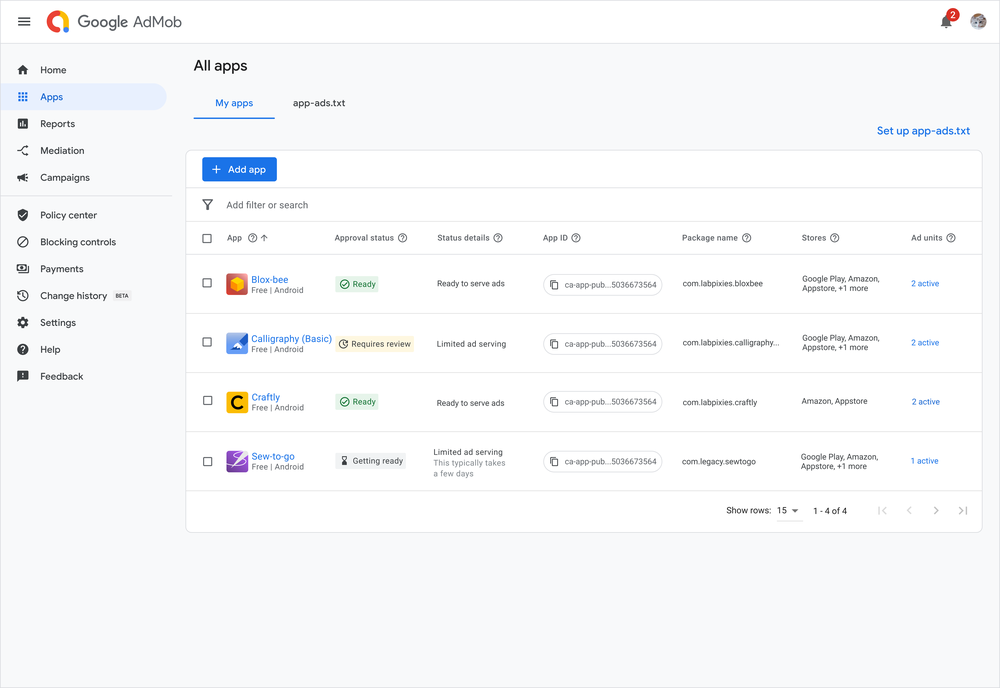
Feed those winning structures back into your LLM to generate 10 to 20 custom scripts tailored to your specific product. From there, you have two options:
- AI Avatars: Use platforms like Arc Ads to generate realistic people reading your scripts.
- Static/B-Roll: Use AI image generators to create static ads, or cut together supplier B-roll using CapCut.
With this pipeline, producing 15 to 25 ad variations in a single afternoon is entirely realistic.
Phase 5: Launch, Scale, and the 30-Day Rule
Once your store is live and your ads are running (starting with simple Facebook ads or organic posting), the system shifts into a weekly operating rhythm.
- Mondays: Run fresh product research and monitor competitors.
- Tuesdays: Review ad performance (kill the losers, scale the winners).
- Wednesdays: Generate new ad scripts and variations.
- Thursdays: Launch new tests.
- Fridays: Update your Profit & Loss (P&L) sheets.
The Golden Rule: Adopt a strict 30-day kill criteria. If you test a product aggressively for a month—trying new angles, hooks, and audiences—and it still isn’t profitable, kill it. No emotions. Move on to the next one. But when a product does catch fire, that’s when you pour gasoline on it, increase your budget, and transition from a quick test into a long-term brand.
Final Thoughts
This AI dropshipping playbook isn’t a magic lottery ticket. You will still test products that flop, and you will still spend money on ads that don’t convert. That is simply the reality of e-commerce.
However, leveraging these workflows acts as a massive force multiplier. If you want to dive deeper into the exact prompts and spreadsheets mentioned, seeking out dedicated AI tutorials on workflow automation is your next best step. The system is out there; the only question is whether you are willing to execute.