


Let me ask you something.
What if you could “hire” someone who works all day, every day… never takes leave, never gets tired, and doesn’t even ask for a salary hike?
Sounds like a fantasy, right?
But it’s not. That “someone” already exists — it’s an AI agent.
And the surprising part? You don’t need to be a developer or tech expert to build one anymore.
So… What Exactly Is an AI Agent?
Honestly, most people think AI agents are just fancy chatbots. I used to think the same.
But there’s a big difference.
A chatbot waits for you to ask something.
An AI agent? It just gets things done.
Imagine this:
You wake up in the morning, open your inbox… and it’s already sorted.
Important emails? Highlighted.
Leads? Added to your system.
Replies? Drafted and ready.
Meetings? Already scheduled.
You didn’t do any of that.
That’s what an AI agent does. It doesn’t just respond — it acts.
What Makes It Different (And Powerful)
From what I’ve seen, real AI agents have three things that make them feel almost like a real assistant:
1. They work on their own
You don’t have to keep triggering them again and again.
2. They make decisions
Not perfect decisions, but good enough to save you hours.
3. They use tools
They can read emails, update spreadsheets, send messages, and even book meetings.
It’s kind of like the difference between a machine and a human helper.
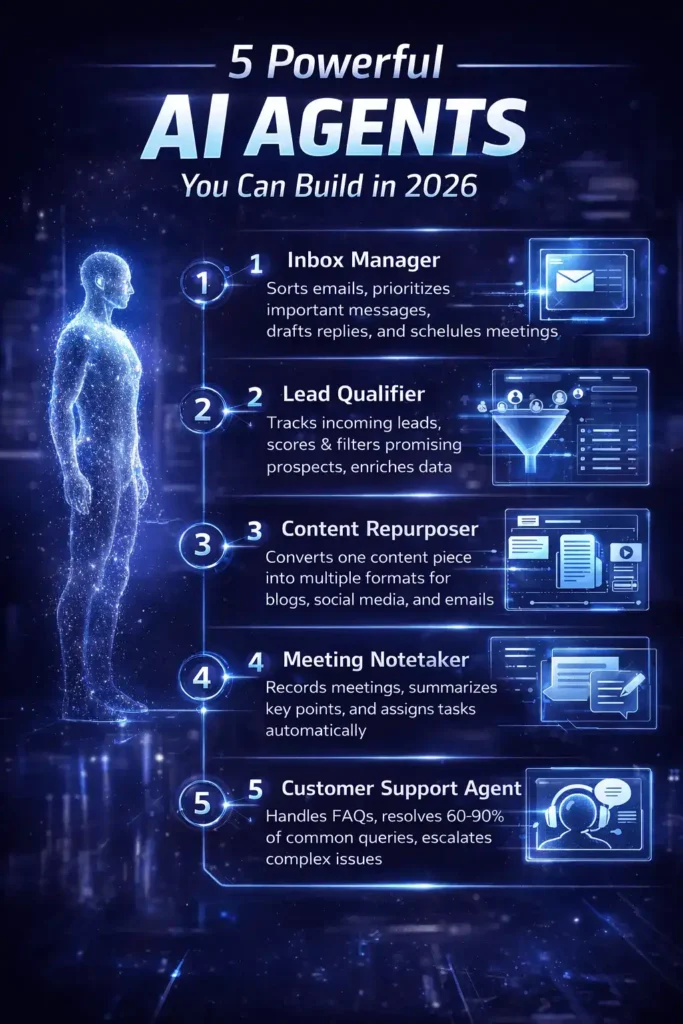
If I Had to Start Today, I’d Build These 5 AI “Employees”
Instead of thinking in terms of software, it’s easier to think like this:
👉 “If I could hire 5 people, what roles would I fill first?”
Here’s what I’d pick:
1. Someone to Handle My Inbox
Emails can get overwhelming fast.
An AI agent can:
- Sort everything
- Highlight what matters
- Draft replies in your tone
You basically go from chaos to clarity.
2. Someone to Filter Leads
Not every lead is worth your time.
This agent:
- Checks incoming leads
- Finds useful details about them
- Pushes the good ones forward
No more wasting time on dead ends.
3. Someone to Repurpose Content
This one is underrated.
You create one piece of content… and the agent turns it into:
- Social media posts
- Emails
- Short-form content
It’s like having a mini content team.
4. Someone to Take Meeting Notes
You attend a meeting, and instead of worrying about notes:
- Everything gets recorded
- Key points are summarized
- Tasks are assigned
And it’s all done before the meeting even “feels” finished.
5. Someone for Customer Support
Most customer questions are repetitive.
An AI agent can handle a huge chunk of them automatically and only pass the tricky ones to you.
That alone can save a lot of time (and money).
Tools You Can Use (Without Overthinking It)
You don’t need to try everything.
If you’re just starting, stick with simple tools like:
They’re straightforward and don’t require coding.
Once you get comfortable, you can explore more advanced tools later.
How I’d Actually Build My First AI Agent
If I had to do it today, I wouldn’t overcomplicate it.
I’d do something like this:
- Sign up on a no-code platform
- Pick a simple template (like email automation)
- Connect my email
- Give clear instructions (in plain English)
- Link it to a spreadsheet or CRM
- Turn it on
That’s it.
Within 15–20 minutes, you’ll have something real working in the background.
One Mistake I’d Avoid
Trying to build everything at once.
That’s where most people mess up.
Instead:
- Start small
- Get one thing working properly
- Then expand
It’s exactly like hiring in real life. You don’t build a full team on day one.
A Simple Plan That Actually Works
If you want structure, here’s a realistic approach:
- Month 1 → Fix your inbox
- Month 2 → Repurpose your content
- Month 3 → Manage leads better
- Month 4 → Automate meeting notes
- Month 5 → Add customer support
By then, you’ll have something that genuinely feels like a small team working for you.
Final Thoughts
AI agents aren’t some “future tech” anymore.
They’re already here.
They’re affordable.
And honestly… they’re easier to set up than most people think.
The only thing stopping most people is hesitation.
So don’t overthink it.
Just pick one task, try one tool, and build your first agent.
You’ll figure out the rest as you go.