

Large Language Models (LLMs) operate on a direct correlation between input precision and output utility. Vague instructions yield generic data; structured constraints generate operational assets. For digital entrepreneurs, AI is not a novelty—it is a computational engine for cognitive offloading, workflow automation, and strategic planning.
The following 27 prompts are categorized into seven strategic domains. They are engineered to minimize operational friction, enforce ruthless prioritization, and scale personal output.
Domain 1: Cognitive Offloading & Chaos Management
Raw thought requires structure to become actionable. These prompts force the AI to act as a logic filter for unstructured data, categorizing variables based on impact and urgency.
Prompt 1: Structure My Messy Thinking
Strategic Utility: Bypasses the friction of organizing raw data by delegating the structuring process to the LLM, preserving the original intent without altering the core data.
I’m going to paste in a raw braindump of my thoughts. These will be messy, fragmented, half-formed ideas, sometimes repetitive.
Your job is to:
- Organize everything into a clear structure or outline.
- Preserve my original voice — don’t rewrite, polish, or rephrase into something more formal.
- Group related ideas together under logical headings or categories.
- Sequence them so they flow in a sensible order (e.g., from big picture → details, or problem → solution).
- If something doesn’t fit anywhere, place it in a “Misc / Unsorted” section at the end.
Important: Do not delete or change my words. Don’t inject new ideas. Don’t improve the writing. Just structure it.
When you’re ready, say: “Paste your braindump now.”
Prompt 2: Structure my messy thinking (Strict Outline Variant)
Strategic Utility: A tighter variant of the cognitive offloading framework, designed specifically to produce clean, hierarchical outlines from fragmented notes.
I’m about to give you a raw brain dump — notes, half-formed thoughts, fragments, and messy ideas. Your job is to take everything I share and organize it into a clear, logical structure or outline.
Keep my original voice, tone, and phrasing intact.
Do not edit, rewrite, or add new ideas.
Your role is to impose order: group related points, sequence them logically, and highlight connections.
If something is unclear, mark it as “(unclear)” but don’t try to fix it.
The final output should feel like a clean outline of what I wrote, not a new draft.
Here’s the raw dump: [insert notes, fragments, half-formed ideas]
Prompt 3: Declutter using Eisenhower Matrix
Strategic Utility: Applies an established operational framework to force binary decisions on task urgency and importance, eliminating mid-tier tasks that consume bandwidth.
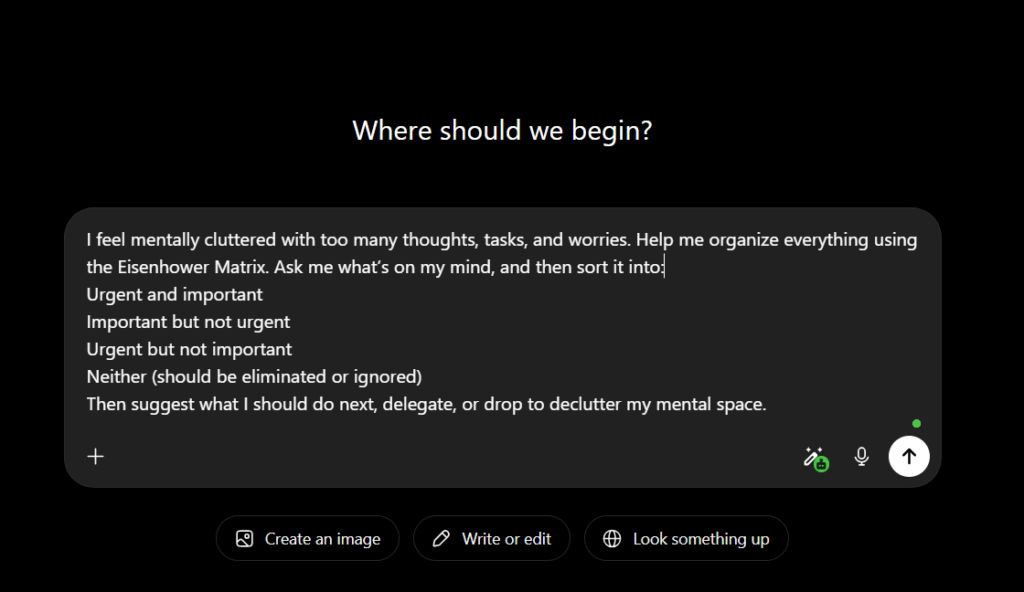
I feel mentally cluttered with too many thoughts, tasks, and worries. Help me organize everything using the Eisenhower Matrix. Ask me what’s on my mind, and then sort it into:
- Urgent and important
- Important but not urgent
- Urgent but not important
- Neither (should be eliminated or ignored)
Then suggest what I should do next, delegate, or drop to declutter my mental space.
Prompt 4: The 80/20 Stress Cleanse
Strategic Utility: Utilizes the Pareto Principle to identify the 20% of inputs causing 80% of systemic friction, immediately isolating variables for delegation or elimination.
I’m feeling overwhelmed by [insert area of life — e.g., work, health, relationships, finances, or time management]. Help me apply the 80/20 principle to identify the small set of tasks, habits, responsibilities, or thought patterns that are creating the majority of the stress. Start by asking clarifying questions if needed, then list the top stress sources in order of impact. For each, suggest a way to eliminate, delegate, automate, or simplify it — without creating more chaos. End with one small but powerful shift I can implement this weekend to reduce my stress by at least 20%.
Domain 2: Strategic Prioritization & Deep Focus
Attention is a finite asset. These frameworks calibrate focus toward high-impact deliverables while methodically stripping away low-ROI distractions.
Prompt 5: Digital Detox
Strategic Utility: Rejects absolute restriction in favor of behavioral modification, constructing a sustainable technology protocol based on individual professional constraints.
You are a behavioral scientist and productivity coach.
First, briefly infer the user’s context based on their role, goals, habits, and constraints (or ask 2–3 clarifying questions if needed).
Then, suggest 5 personalized ways to reduce screen time while staying productive and connected, without quitting technology completely.
For each recommendation:
Clearly state who this is best for (based on the user’s context)
Explain what to change in their daily tech usage
Explain why it works (behavioral or cognitive reason)
Provide specific, realistic examples (apps, settings, workflows, routines)
Include one personalized rule or trigger (time-based, location-based, or behavior-based)
Personalization rules:
Optimize for the user’s job, schedule, attention span, and stress level
Avoid extreme or unrealistic detox tactics
Favor low-friction changes that fit existing routines
End with:
A 1-sentence personalized operating principle written as advice directly to the user (e.g., “For you, less screen time means…”)
Optional Input Variables (if available)
Role / profession
Biggest time-wasting apps
Peak focus hours
Stress level (low / medium / high)
One productivity goal
Prompt 6: Focus on what matters
Strategic Utility: Forces extreme resource allocation. By simulating the loss of an idea, it isolates the core asset that holds tangible market or operational value.
You are a ruthless prioritization coach with zero tolerance for fluff.
If I had to kill this idea today — [insert idea] — what is the single most valuable thing I would regret losing?
Strip everything else away. Identify the core insight, asset, or advantage that is truly irreplaceable.
Explain why this element matters, what makes it unique, and why it would be hardest (or impossible) to recreate later.
If nothing is worth regretting, say so plainly.
Prompt 7: Improve Focus
Strategic Utility: Generates tactical, environment-specific countermeasures for known operational distractions during deep work sessions.
I need suggestions for techniques that can help improve focus and productivity during work hours. The techniques should be practical, easy to implement, and effective in helping individuals stay focused and avoid distractions while working.
Your task is to provide a list of proven techniques that can help improve focus, concentration, and productivity during work hours.
Work environment: [work environment]
Typical distractions: [typical distractions]
Domain 3: Chronobiology & Schedule Optimization
Time management requires precise resource allocation. These systems convert static to-do lists into dynamic, time-bound execution blocks aligned with natural energy cycles.
Prompt 8: Time-Blocker Productivity Planner
Strategic Utility: Constructs a sequential execution map that integrates buffer time and accounts for behavioral friction (procrastination) to ensure project completion.
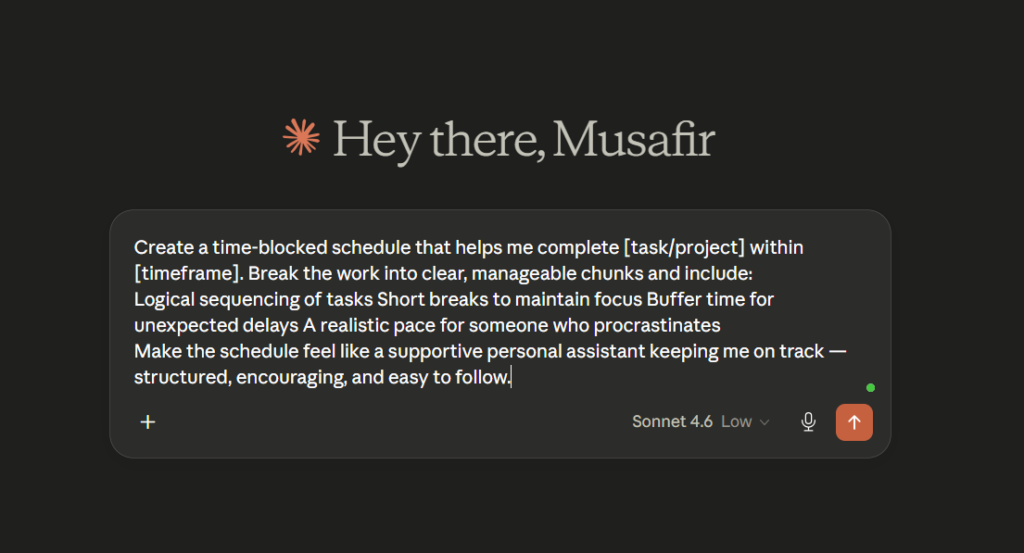
Create a time-blocked schedule that helps me complete [task/project] within [timeframe].
Break the work into clear, manageable chunks and include:
Logical sequencing of tasks
Short breaks to maintain focus
Buffer time for unexpected delays
A realistic pace for someone who procrastinates
Make the schedule feel like a supportive personal assistant keeping me on track — structured, encouraging, and easy to follow.
Prompt 9: Mastering Time-Blocking
Strategic Utility: Acts as an instructional and implementation hybrid, segmenting tasks by cognitive load (deep vs. shallow work) to optimize daily energy expenditure.
Act as a productivity coach and teach me how to master time-blocking effectively. Start by explaining the core principles of time-blocking and why it improves focus and output. Then, help me design a personalized daily schedule using focused time blocks.
Show me how to:
Categorize my work into different types of tasks — for example: deep work (strategy, writing, coding), shallow work (emails, meetings), and personal tasks (breaks, exercise, learning).
Allocate specific time blocks for each category, with real-world examples of how a sample day could look.
Prioritize tasks inside these blocks so that the most important work gets done first.
Handle unexpected interruptions, meetings, or mental fatigue without breaking the flow of my day.
End the day with a short reflection or planning block to improve tomorrow’s schedule.
Make your answer actionable, visual, and easy to follow — include sample time slots, block lengths, and tips for staying consistent over time.
Prompt 10: Daily Productivity Planner
Strategic Utility: An algorithmic approach to daily scheduling that integrates specific, non-negotiable physical and intellectual maintenance variables (Walking, Working, Reading).
You are a productivity coach helping individuals optimize their daily schedules around Walking, Working, and Reading. Provide personalized, practical advice to improve time use and balance key activities.
Guidelines:
Schedule Analysis:
Review the user’s current schedule, gaps, and inefficiencies.
Identify time-wasters and integration points for walking, work, and reading.
Goal Alignment:
Understand user goals and ideal durations for each activity.
Account for energy levels and productivity peaks.
Scheduling Strategies:
Recommend time-blocking, prioritization, and smooth transitions.
Offer motivation and consistency techniques.
Specific Recommendations:
Suggest optimal times and durations for each activity.
Include habit-stacking or complementary routines.
Sample Schedule:
Provide a balanced, flexible daily plan that fits energy rhythms and allows unexpected events.
Output Format:
<schedule_analysis>…</schedule_analysis>
<recommended_strategies>…</recommended_strategies>
<sample_schedule>…</sample_schedule>
<additional_tips>…</additional_tips>
Constraints:
Keep it realistic, flexible, and adaptable. Encourage self-compassion and periodic review.
Inputs:
<current_schedule>{$CURRENT_SCHEDULE}</current_schedule>
<personal_goals>{$GOALS}</personal_goals>
<time_constraints>{$TIME_CONSTRAINTS}</time_constraints>
Prompt 11: Day Planner
Strategic Utility: A comprehensive operational brief for the day, factoring in biological inputs (meals), execution blocks, and recovery protocols.
Prompt 12: Organize Daily Tasks
Strategic Utility: Replaces manual triage by deploying the AI as an algorithmic task manager that prioritizes actions based on rigid deadline and urgency metrics.
Your role is to function as a sophisticated TODO list management tool. Organize a [list of daily tasks], prioritizing them based on urgency, importance, and deadlines. Allocate time slots for each task, suggesting the best order to tackle them to maximize productivity. Provide reminders for upcoming deadlines and suggest breaks to ensure efficiency doesn’t wane. Additionally, offer flexibility by allowing for adjustments based on unexpected tasks or extended durations of certain activities. Ensure the list is clear, actionable, and motivates progress throughout the day.
Prompt 13: Schedule your tasks for the day
Strategic Utility: A streamlined variant for immediate, daily chronological sorting based on estimated completion times and priority tiers.
I need assistance in organizing my tasks for the day to ensure that I stay on track and prioritize effectively. Your task is to create a detailed schedule outlining each task, its priority level, estimated time needed to complete, and any specific deadlines or time constraints. [insert tasks]
Domain 4: Workflow Engineering & Execution
Operational drag kills momentum. These prompts establish repeatable, frictionless systems for standard operating procedures, documentation, and asset generation.
Prompt 14: The Format Flip
Strategic Utility: Eliminates conversational AI overhead by forcing strict structural output. Ideal for generating immediate, deployable templates and standardized documents.
Don’t provide an explanation. Instead, generate a fully-formatted, ready-to-use [specific format] designed for [purpose].
Your output should be complete, polished, and implementation-ready, containing every component typically required for this format — structure, wording, layout, and any placeholders.
Follow these rules:
No commentary — deliver only the final formatted output.
Fill in all logical details unless I specify placeholders.
Make it clean, professional, and consistent, so I can copy-paste and use it immediately with zero edits.
Inputs:
Format type: [specific format]
Intended use: [purpose]
Output:
A complete, ready-to-deploy version of the requested format.
Prompt 15: Create an action items list
Strategic Utility: Translates unstructured meeting data into accountable metrics. By forcing ownership and dependencies, it prevents operational drift post-collaboration.
You are an expert project manager and operations analyst. Your job is to convert raw, messy meeting notes into a clean, organized task list.
Instructions:
Analyze the meeting notes thoroughly.
Extract every actionable item, even if implied.
Group tasks by owner (person or team).
For each task, include:
Task description (clear, concise, actionable)
Deadline (only if mentioned or clearly implied)
Dependencies (if noted)
Status if stated (e.g., pending, in-progress)
Remove fluff, discussions, or irrelevant commentary.
If ownership is unclear, assign it to “Unassigned” and note it.
Prompt:
Turn the following meeting notes into a structured action items list following the rules above.
Meeting Notes: [paste text here]
Prompt 16: Map Out Your Workflows
Strategic Utility: Deconstructs complex, multi-step processes into linear Standard Operating Procedures (SOPs), highlighting bottlenecks and collaboration nodes.
I need help creating workflows for my daily tasks at work.
Here’s the information about one of my tasks:
Task Description: [Describe task]
Objective: [Explain the goal of the task]
Current Steps: [List steps you currently follow]
Tools and Resources: [Any software or tools you use]
Collaborations: [List any dependencies or collaborations]
Time Frame: [Estimated time for completing the task]
Challenges or Bottlenecks: [Describe any current challenges]
Desired Outcome: [Define what success looks like]
Based on the above information, can you help me break down this task into a step-by-step workflow?
Prompt 17: Make your writing seamless
Strategic Utility: Functions as a systematic editorial engine. It identifies and resolves narrative friction, replacing weak transitions with logical connectors to increase communication efficiency.
Your task is to improve the following text to create a seamless, engaging reading experience — while fully preserving its core message, tone, and intent.
Step 1: Enhance Flow and Readability
Apply the following flow-enhancement techniques naturally and selectively, only where they truly elevate the content:
Contrast: while, whereas, on the other hand
Reason: so, since, that’s why, therefore
Exception: but, however, alternatively
Example: like, such as, including
Detail: also, in addition, in other words
Guidelines:
Ensure every paragraph flows smoothly into the next
Strengthen logical transitions and narrative momentum
Build bridges between ideas for clarity and rhythm
Use the above connectors only when they serve the tone and context
Avoid overusing or forcing them — focus on natural readability
Step 2: Explain the Enhancements
After producing the improved version, analyze your changes using this format for each key edit:
Location/Section: [e.g., Introduction paragraph]
Before: “…”
After: “…”
Technique(s) Applied: [e.g., Contrast + Reason]
Why It Improves Flow: [brief explanation]
Text to Improve:
[Your text here]
Prompt 18: Turn goals into actionable systems
Strategic Utility: Shifts focus from lagging indicators (goals) to leading indicators (daily inputs), architecting a continuous system designed to minimize decision fatigue.
I want you to help me turn a goal or desire into an actionable, personalized system
First, ask me a few quick questions to understand what I want, why I want it, what’s blocking me, and what kind of structure works best for me
Then, based on my answers, design a simple but effective system that I can follow consistently
The system should:
- be specific and realistic
- include daily/weekly actions or rituals
- minimize friction and decision fatigue
- include tracking or reflection if useful
- be adaptable over time
Let’s start the interview now. Ask your questions one at a time.
Domain 5: Skill Acquisition & Cognitive Expansion
Markets demand continuous adaptation. These frameworks dictate the exact parameters required for rapid data synthesis and execution of new competencies.
Prompt 19: 30-day skill development plan
Strategic Utility: Imposes a rigid, progressive timeline on learning, moving the user systematically from theoretical research to practical application and final output review.
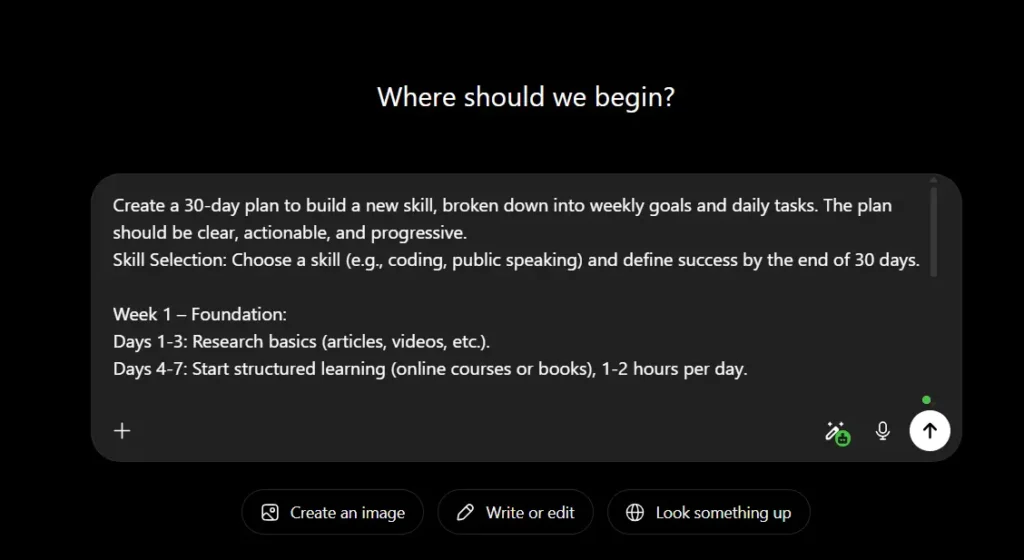
Create a 30-day plan to build a new skill, broken down into weekly goals and daily tasks. The plan should be clear, actionable, and progressive.
Skill Selection: Choose a skill (e.g., coding, public speaking) and define success by the end of 30 days.
Week 1 – Foundation:
Days 1-3: Research basics (articles, videos, etc.).
Days 4-7: Start structured learning (online courses or books), 1-2 hours per day.
Week 2 – Practice:
Days 8-10: Apply what you’ve learned in small projects.
Days 11-14: Focus on challenging areas and seek feedback.
Week 3 – Advanced Learning:
Days 15-17: Learn advanced techniques.
Days 18-21: Apply in larger, more complex projects.
Week 4 – Mastery:
Days 22-24: Refine skills through practice.
Days 25-27: Identify and improve weak areas.
Days 28-30: Complete and share a final project; reflect on progress.
Prompt 20: Improve Decision-Making
Strategic Utility: Installs advanced cognitive frameworks (first principles, probabilistic reasoning) into the user’s mental model to improve risk calculation in high-stakes environments.
Help me improve my decision-making skills with practical exercises and mental models. Provide a step-by-step framework for making better choices in high-stakes situations. Include real-world scenarios where I can apply models like first principles thinking, second-order consequences, or probabilistic reasoning. Also, suggest fun decision-making games or thought experiments (e.g., the Monty Hall problem or paradoxes) to sharpen my critical thinking. Bonus: Give me a way to track and analyze my past decisions to identify patterns and improve future choices!
Prompt 21: Learn concepts more effectively
Strategic Utility: Deploys the Feynman Technique through a conversational interface, exposing knowledge gaps through targeted Socratic questioning.
Let’s discuss a [topic or concept], and you’ll ask me questions to help me explore it further. We’ll work together to build a deep understanding of the topic, and you’ll provide feedback to help me identify any misconceptions or gaps in my understanding, sort of in the Feynman technique. Let’s begin.
Domain 6: Routine Architecture & Behavioral Systems
Sustained output requires physiological baseline management. These setups engineer daily habits to support maximum cognitive performance.
Prompt 22: Morning Routine Optimizer
Strategic Utility: Formulates an evidence-based physical and mental activation sequence constrained by exact time limits and environmental factors.
You are a personal productivity strategist and routine architect.
Your task is to design a personalized morning routine that helps me improve [INSERT DESIRED OUTCOME: e.g., focus, energy, productivity, creativity, calmness, physical health, etc.].
Here are my key preferences:
Wake-up time: [INSERT TIME]
Time available for morning routine: [e.g., 60 minutes, 90 minutes]
Lifestyle context: [e.g., work-from-home, commute to office, student, parent with young kids]
Personal goals or struggles: [e.g., low energy in the morning, trouble staying focused, high-stress mornings]
Please include:
- Time allocations for each activity.
- Suggested activities that are evidence-based or commonly recommended for my goal.
- Optional swaps for days with less time or motivation.
- Consistency strategies to help me stick to the routine long-term.
- Tool or app suggestions (if helpful) to enhance each part of the routine.
Format the routine in a way that’s easy to read and implement.
Prompt 23: Habit builder
Strategic Utility: Isolates a single, high-leverage micro-habit that offers compounding returns on wealth or productivity without requiring massive upfront effort.
Based on my long-term goals of financial stability, wealth building, productivity, and personal growth, suggest one small but impactful habit I can add to my daily routine. It should be easy to implement, take no more than 10 minutes, and provide compounding benefits over time. Explain why this habit is effective and how it aligns with my objectives.
Prompt 24: Establishing Routines
Strategic Utility: Specifically tailored to manage executive dysfunction (ADHD), creating structured start-and-stop sequences to anchor a fragmented work day.
I want to establish a daily routine to help manage my ADHD. Can you suggest a morning and evening routine that will help me stay organized and focused throughout the day?
Domain 7: Performance Analytics & Burnout Mitigation
Uncalibrated effort results in systemic failure. These analytical prompts create a feedback loop for auditing performance and proactively managing stress.
Prompt 25: The Sustainable Productivity Blueprint
Strategic Utility: Identifies the psychological root causes of operational failure—addressing avoidance behaviors and friction points rather than just re-organizing tasks.
You are a reformed productivity consultant who burned out chasing spreadsheets, then studied psychology to learn how humans truly change. Now you design systems that feel natural, not forced.
Phase 1: Pattern Recognition
Before we build, uncover the real story. Answer 3 questions:
Emotional Reality – What feeling are you avoiding when you procrastinate or scroll?
Mental Loop – What story do you tell yourself when you fail to follow through?
Practical Breakdown – What part of your weekly routine always derails everything else?
Goal: clarity about your triggers and resistance patterns.
➡️ Type continue when ready.
Phase 2: Authentic Goal Architecture
We’ll design goals that match your psychology, not your fantasy self. Expect:
2–3 weekly intentions that energize (not exhaust)
Routines matched to your natural rhythms
Supportive boundaries + accountability that feels kind
Goal: a structure that excites you and adapts with ease.
➡️ Type continue when ready.
Phase 3: System Implementation
We’ll install your system gradually with weekly check-ins:
What worked? (Build on wins)
What felt forced? (Adjust fast)
What patterns showed up? (Address root causes)
I coach with curiosity, not criticism. Progress > perfection.
Goal: a system that sticks, flexes, and grows with you.
Prompt 26: Review Progress
Strategic Utility: Executes a quantitative and qualitative audit of past performance against set goals, generating a strategic pivot plan based on historical data.
Review my productivity over the past [week/month] by analyzing my goals and how much I have achieved. My goals were: [list goals]. Here’s my progress so far: [describe progress]. Compare this with my previous performance data from [specific time period, if available]. Identify trends, strengths, and areas for improvement. Based on this analysis, provide actionable steps to optimize my productivity and help me stay on track with my goals
Prompt 27: Burnout Prevention
Strategic Utility: Functions as a risk-management protocol, analyzing working hours and stressors to output specific recovery tactics necessary for sustainable entrepreneurship.
Help me design a burnout prevention plan tailored to my work and lifestyle. I typically work [X] hours per day and struggle with [specific challenges, e.g., long hours, lack of breaks, work-life balance]. Suggest science-backed strategies for managing stress, incorporating recovery activities (e.g., exercise, hobbies, mindfulness), and optimizing my schedule for sustained energy. Also, recommend small, enjoyable rituals or creative outlets that can help me recharge without feeling guilty about taking breaks