
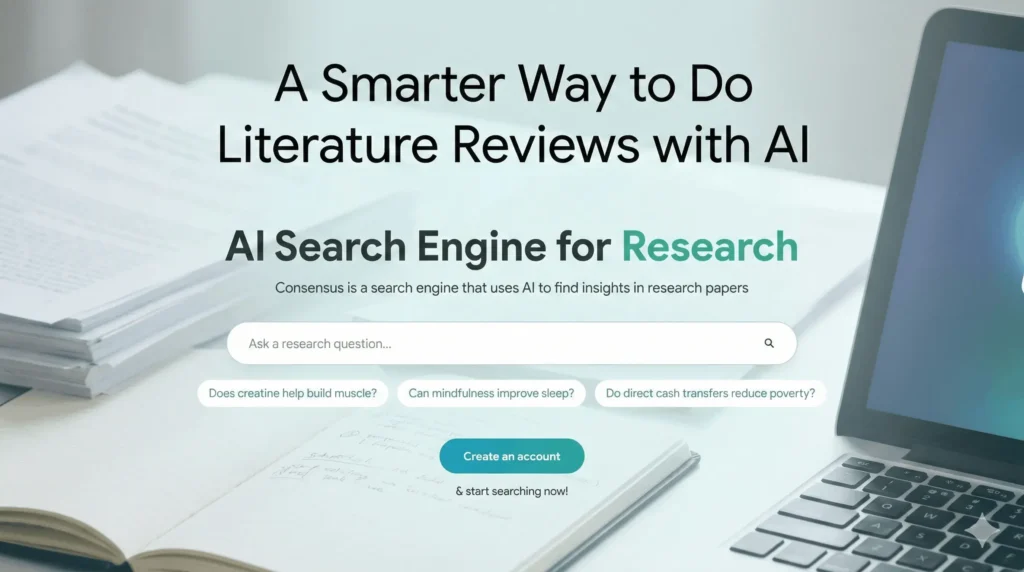

If you’ve ever done a literature review, you already know how messy it can get. You open Google Scholar, search your topic, and suddenly there are PDFs everywhere. You open one paper, then another, then five more. Every study says something a little different, and after a while you’re just tired and confused, wondering what the research actually agrees on.
That’s exactly how I used to feel too. And if you’ve been there, this will probably make sense to you.
In this post, I want to talk about a tool called Consensus and how it can make literature reviews much easier—especially if you’re a student or researcher who doesn’t want to waste weeks just figuring out where to start.
So, What Exactly Is Consensus?
Consensus is basically a search engine made only for academic research. It looks through millions of peer-reviewed studies and gives you answers that are backed by real papers, not blog posts or opinions.
The easiest way to think about it is this:
it feels like Google Scholar, but instead of dumping links on you, it actually tells you what the research says.
And unlike general AI tools, it’s focused completely on scientific literature.
Use Case 1: Starting a Literature Review Without Stress
Let’s say you’re an undergraduate student and your professor asks you to write a paper on the effect of screen time on sleep quality. You don’t really know where to begin, so you go to Consensus and ask a simple question:
Does screen time affect sleep quality?
Within a few seconds, you get an answer along with something called a Consensus Meter. This meter shows you how researchers feel about the question overall.
In this case:
- About 84% of studies say yes
- The remaining studies show mixed results
At a glance, you already understand the general direction of the research. That alone saves a lot of time.
Below the meter, there’s a short summary explaining what the studies are saying. What I really like here is that every point is linked to actual citations. If you click on one, it takes you directly to the paper where that information comes from.
Finding Good Papers Without Guessing
Another useful thing Consensus does is help you see which papers are actually worth your attention.
It labels studies clearly, like:
- observational studies
- highly cited papers
- papers published in strong journals
So if you see a paper with over 200 citations, you immediately know it’s an important one.
Some papers also have an “Ask This Paper” option. When the full PDF is available, you can ask questions like:
- What is this paper really arguing?
- What are its main findings?
- What are the limitations?
This makes the early stage of a literature review much clearer than randomly opening PDFs and hoping for the best.
Just one small thing to remember: if you want the Consensus Meter to work, make sure your question can be answered with yes or no.
Use Case 2: Finding a Research Gap for Your Thesis
For master’s and PhD students, one of the hardest parts is deciding on a research question.
Imagine you’re a civil engineering student working on improving concrete strength. You read somewhere that recycled plastic might be used in concrete, but you’re not sure if it actually works.
So you ask:
Does using recycled plastic in concrete affect its strength?
Now the Consensus Meter shows something interesting:
- 50% say yes
- 42% say no
- 8% show mixed results
This tells you right away that the research community doesn’t fully agree. That’s usually a sign that there might be a research gap worth exploring.
Looking Deeper Instead of Guessing
Consensus lets you dig deeper instead of jumping to conclusions.
First, you can check how recent the studies are. In this case, papers saying “no” are slightly more recent than those saying “yes.” That could mean newer research is challenging older ideas.
Next, you can look at journal quality. Here, both sides are published in similarly strong journals, so quality isn’t the main difference.
Then you check citations. The papers supporting the “yes” side have been cited much more often, which suggests there is stronger existing evidence there.
You can even filter the results further, like choosing to see only Q1 journal papers. After applying that filter, the balance shifts more clearly toward “yes.”
Doing this kind of step-by-step checking helps you understand the research properly instead of just guessing where the gap is.
Use Case 3: Adding Citations While Writing
Another very practical use of Consensus is when you’re actually writing your paper.
Say you’re working on the introduction and you write something like:
“Intermittent fasting has been shown to improve metabolic health.”
If you don’t already have citations for that line, you can paste it into Consensus. It will show you papers that support the statement.
From there, you can:
- filter by year
- choose only high-quality journals
- pick your citation style
- save papers to your reference manager
It’s a simple way to make sure your writing is properly supported by research.
Final Thoughts
Consensus isn’t magic, but it does remove a lot of unnecessary struggle from academic work. It helps you:
- understand what research actually agrees on
- start literature reviews with clarity
- identify possible research gaps
- support your writing with real citations
For students and researchers, that alone makes a big difference.
The Consensus team has also offered one year of free premium access for the WiseUp audience. You can use the code mentioned in the description to try it out yourself.
And if you want to learn how to write a research paper from start to finish, including how to use AI tools responsibly, there’s a full A to Z research paper writing course linked in the description as well.